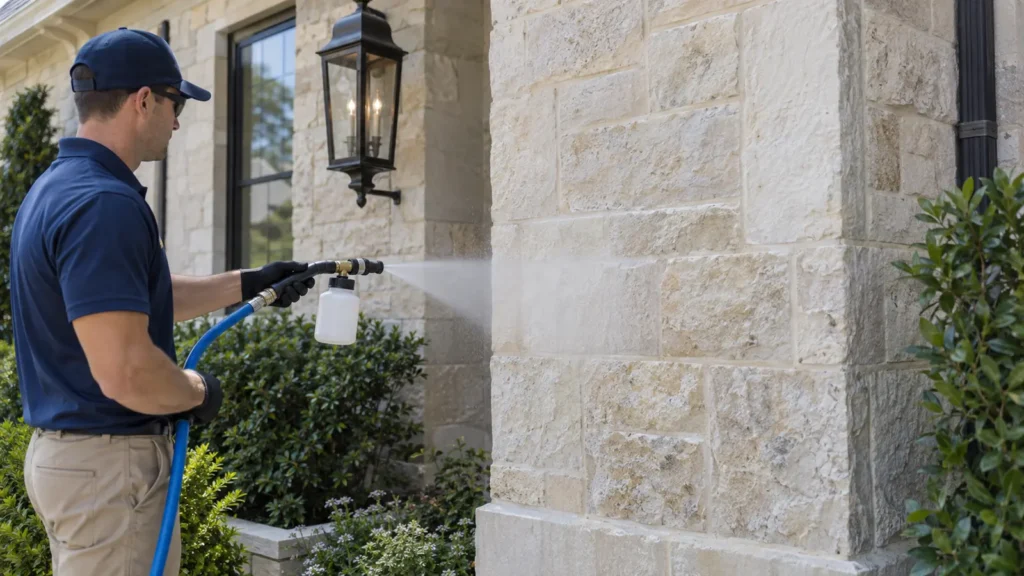
Quick answer: If you plan to pressure wash limestone in Fort Worth, do not use the same high-pressure setup used on concrete. Limestone is porous and can be marked, eroded, or unevenly lightened by excessive pressure. A professional should identify the stone, test a small area, choose the least aggressive effective method, and control both the cleaning solution and rinse pressure.
Fort Worth-area homes often use natural stone on facades, columns, walkways, patios, and outdoor living spaces. These surfaces can collect algae, soil, irrigation residue, and atmospheric film. The buildup may look simple, but the wrong cleaning method can change the face of the stone or damage mortar joints.
Why high pressure can damage limestone
Concrete and limestone do not respond to cleaning in the same way. Dense, sound concrete can tolerate controlled pressure that would be too aggressive for softer or weathered masonry. Limestone also varies in porosity, finish, age, and previous treatment, so there is no single safe pressure setting for every property.
The National Park Service guidance on cleaning masonry recommends starting with very low pressure and increasing only as necessary. Its guidance also emphasizes testing, selecting the gentlest effective approach, and considering the masonry’s condition before cleaning.
Common signs of an overly aggressive cleaning method
- Visible wand lines or a striped finish
- A rougher surface where the outer face has been eroded
- Loose sand, grit, or mortar after washing
- Uneven color caused by inconsistent pressure or dwell time
- Water entering joints, cracks, doors, windows, or wall cavities
- Damage to sealers or nearby painted and metal surfaces
Damage may not be obvious while the stone is wet. The true appearance often becomes clearer after the surface dries, which is another reason to test an inconspicuous area first.
How professionals pressure wash limestone in Fort Worth more safely
Patrick Window Cleaning’s specialty exterior cleaning service begins with material identification. The crew then selects a cleaning approach suited to the stone, its finish, and the type of buildup.
Inspect the stone and nearby materials
The technician checks porosity, open joints, cracks, previous coatings, and adjacent surfaces. Runoff paths, landscaping, windows, electrical fixtures, and metal accents also affect the work plan.
Test the least aggressive method first
A small test area shows whether the chosen solution changes the color, leaves residue, or affects the surface. The test also helps determine the needed dwell time and rinse method before the full area is treated.
Use chemistry to loosen buildup
Soft washing relies on an appropriate cleaning solution and controlled dwell time instead of brute force. The product must match the stain and the stone. Organic growth, irrigation deposits, rust, and oily residue do not all respond to the same treatment.
Rinse with controlled pressure
The rinse should remove loosened material without cutting into the stone or forcing water through joints. Technicians also manage overspray and protect surrounding plants before, during, and after treatment.
When pressure washing is appropriate
Pressure washing remains useful for durable hardscapes when the material and condition support it. Patrick Window Cleaning provides pressure washing for concrete, brick, and paver surfaces. The team assesses the surface and stain before choosing pressure, pretreatment, and equipment.
A contractor should not assume that every pale stone surface is limestone or that every dark stain is mold. Correct identification comes before equipment selection.
When to request professional limestone cleaning
Request an assessment when the stone has widespread organic growth, dark runoff streaks, sprinkler residue, oxidation from nearby metal, unknown sealers, loose mortar, or previous pressure-washing marks. Professional evaluation is also sensible for tall facades, walls above delicate landscaping, and stone near windows or electrical fixtures.
If the stone is structurally loose, deeply cracked, or actively shedding material, cleaning may need to wait until a qualified masonry professional evaluates the condition.
Protect the stone before cleaning begins
Patrick Window Cleaning serves homeowners across Fort Worth, Weatherford, Willow Park, Aledo, Westlake, Trophy Club, and surrounding areas. Request a free exterior cleaning quote or call 817-752-7675 and describe the stone, staining, and affected area.
Frequently asked questions
Can a pressure washer permanently mark limestone?
Yes. Excessive pressure, a narrow nozzle, or uneven technique can erode the surface and leave visible lines or color differences.
Is soft washing safe for every type of natural stone?
No single process is safe for every stone and stain. The material, finish, condition, previous coatings, cleaning solution, dwell time, and rinse pressure must be evaluated together.
Can limestone be cleaned with household bleach or acid?
Avoid experimenting with strong household chemicals. An unsuitable product can discolor stone, affect mortar, harm landscaping, or react with nearby metals. Have the stain and material identified first.
How often should exterior limestone be cleaned?
There is no fixed schedule for every property. Shade, irrigation, tree coverage, drainage, airborne dirt, and previous sealing all affect how quickly buildup returns.